
Monopoly Round-Up: Bombshell Document Details Watergate-Style Corruption at the Antitrust Division
I think this is a must-read. And the story probably applies to many DOJ actions that didn't smell right. Glyphosate amicus briefs anyone? E.O.s?

From the fabulous Matt Stoller: my favorite expert on monopolies and anti-trust doings. I have come to believe that the lack of anti-trust enforcement in the US is one of our very biggest problems, leading us to the point that only one company will exist. Okay, maybe not one company, but the control of pricing and markets that monopoly power conveys will bankrupt many of us. It has already done so to 160,000 farmers in 7 years. The rest of us are not that far away.
BTW, I think DOJ corruption today is a lot bigger than Watergate ever was. And we don’t know about the other federal agencies and the process by which their decisions are made.

Monopoly Round-Up: Bombshell Document Details Watergate-Style Corruption at the Antitrust Division
From Ticketmaster to Paramount to Hewlett Packard, the Trump administration and corporate America are involved in an orgy of corruption. Finally, we are seeing the first rea investigation take place.
Mar 15, 2026
Lots of monopoly news this week, as usual. Economic growth slowed, the $2 trillion unregulated segment of Wall Street known as private credit is tottering as a top private equity official calls lenders ‘arrogant,’ fertilizer and oil prices are going haywire due to the conflict in the Middle East, and there was huge drama in the Ticketmaster antitrust case as Trump tried to give the company a pardon, but state-level enforcers effectively said ‘Hell no.’ All of that is in the round-up after the paywall.
Before getting to the full slate of news, I want to focus on an explosive and little-noticed document filed on Friday that represents the first meaningful in-depth investigation into the Trump Presidency that could have significant legal repercussions. And it has to do with an antitrust case.
Watergate Was About Corporate Power
One of the surprising things I found when doing archival research for my book is that Congressman Wright Patman, the populist from Texarkana behind key antitrust and financial services laws, conducted the first investigation of Watergate. His was part a series of Congressional probes into the scandal that at first went nowhere.
In 1972, Patman used his perch as Chair of the Banking Committee to try and issue subpoenas for bank records and to compel the appearance of Nixon officials. But he was overruled by Democrats on his own committee, and liberal groups like Common Cause thought that going at Nixon so close to a Presidential election was too political.
I talked to the investigator on the case, and he said that Patman knew the story cold within two weeks of the break-in, but couldn’t prove it. So after Patman’s own side voted against him, he handed his files to Senator Sam Ervin, whose committee continued the investigation, and over the next few years, a variety of courts, journalists and committees kept at it. And Nixon resigned just two years later.
Watergate was seen as a case about a break-in. It was more broadly a conspiracy to cover up widespread campaign finance misdeeds, with links to the Vietnam War, and corruption around the ITT antitrust case. Once investigators pulled on various strings, it all came undone.
Trump Has a Ticketmaster Corruption Problem
And with that, let’s go to the most high-profile situation in the antitrust world this past week, which was the fiasco around Live Nation/Ticketmaster, a case that may help, in a similar round-about way, erode the Trump Presidency. That case was filed in 2024, and went to trial two weeks ago in a New York City courtroom, in front of a jury of normal people.
The argument put forward by the Department of Justice and dozens of states is that Live Nation/Ticketmaster has market power in ticketing software, artist promotion, and performance venues, and uses these different lines of business to extract revenue, fortify their competitive advantages, and extend their monopolies. It’s a widely loathed company, on both sides of the aisle; one of their biggest critics is Trump-supporting artist Kid Rock.
It was a reasonable case, with documents coming out showing Live Nation executives talking about how stupid their customers were and how they were “robbing them blind.” But on Monday, Live Nation surprised everyone, including the judge, with the announcement they had settled the case with the Trump Department of Justice. The trial, they thought, would end.
The deal reached by the company and Trump would compel Live Nation to allow rival ticket sellers to use its platform for secondary ticket sales, force it to give up control, though not ownership, of just 13 amphitheaters nationwide, and have a modest payout to states. There have been multiple such “settlements” in the last twenty years, and Live Nation’s monopoly power has only grown. So this settlement was widely seen as a corporate pardon by Trump of a hated monopoly.
And the process amplified that impression. The judge called the circumstances “mind boggling.” You are not supposed to surprise judges, you are supposed to tell them you are in negotiations. But Live Nation, whose strategy is led by a boomer antitrust lawyer named Dan Wall, did not do that. In fact, the DOJ’s own lead litigating attorney, David Dahlquist, didn’t even know about the settlement, and neither did the state attorneys general who were co-plaintiffs. I suppose the goal was to shock the state co-plaintiffs into accepting the deal, since they were unprepared to take over the trial.
But instead of working, the gambit backfired. The judge said the state attorneys general must continue the trial on Monday, without the DOJ, or settle. And 33 of them chose to move forward. These state officials were mostly Democratic, but some - like Texas’s Ken Paxton - are conservative enforcers. And a few, such as Colorado Attorney General Phil Weiser, are experienced at overseeing antitrust cases. Moreover, they hired a rock star antitrust lawyer, Jeff Kessler, to take over the case. Kessler has a long and illustrious career, his last win was beating NASCAR on behalf of Michael Jordan. This guy is not someone Live Nation wanted to face.
The backstory of this whole deal is, unsurprisingly, corruption. Live Nation has on retainer influential Republican Kellyanne Conway, as well as Mike Davis, a MAGA lobbyist close to Donald Trump and Pam Bondi. Months ago, Davis was able to force the ouster of the previous Antitrust chief, Gail Slater. Davis has a book of business, including forcing through the merger of two of the biggest real estate brokerages in America without the DOJ asking any real questions.
Now the Division is led by an inexperienced MAGA acolyte named Omeed Assefi, who promptly did what Live Nation’s CEO, Michael Rapino wanted. (And that’s despite Assefi’s work on a related case that had evidence of “the leading national ticketing provider” acting as an accomplice in criminal activity. See Exhibit B.)
So how might this trial help destroy the Trump Presidency? It is linked to the first real investigation of the administration by anyone with any power, which is the Democratic state attorneys general themselves. These people are co-plaintiffs in a bunch of different cases with the Trump Justice Department, and the Live Nation settlement isn’t the first time they’ve witnesses such bad acts.
An Explosive Document
“The series of events that led to the Settlement are unprecedented and should shock the conscience.” - Phil Weiser, Colorado Attorney General
The first illustration of deep corruption in the Trump antitrust world was in July of last year, over a deal orchestrated by computing giant Hewlett Packard to buy its rival Juniper Networks for $14 billion.
Every antitrust settlement has to be overseen by a judge, according to a law passed in the wake of Watergate known as the Tunney Act. After the Trump DOJ settled with Hewlett Packard, state officials intervened in the Tunney Act proceeding, and asked the judge, a former labor lawyer named Casey Pitts, to allow them to investigate and oppose the settlement. Pitts allowed the deal to close, but also gave state officials the right to depose the lobbyists and DOJ officials involved, as well as get documents.
So they did. And state enforcers, led by Weiser, just filed a little-noticed document on Friday alleging widespread corruption in this deal, the result of part of the investigation. It’s a request to the judge not to approve the settlement with HPE, based on multiple violations of law and attempts to deceive the court. Much of it is redacted, but what it shows is that the same network of Ticketmaster-hired lobbyists were also tied into this deal. And it also shows that key figures in corporate America are, well, quite dirty.
What makes this document unusual is that the states were able to put a bunch of Trump officials and lobbyists, as well as corporate officers, in legal depositions and force them to answer questions. Some of the lobbyists are personally close to Donald Trump, and lobbied him directly on the matter. And there was an internal Trump witness, Roger Alford, who testified about wrongdoing he personally witnessed. The states were also able to get lawyers deposed, which is extraordinary. Witnesses in a deposition have to answer questions honestly, under penalty of perjury and a potential charge of obstruction of justice. So it’s a serious investigation.
Here’s what it says, boozy martinis at exclusive Washington clubs and all.
First, Weiser discusses how the Department of Justice should have blocked this merger, but did not. That is the least important part of the document, but it is necessary to explain. Juniper, Hewlett Packard, and Cisco are the three key suppliers of wifi systems for big campuses, like universities, hospitals, and corporations. Juniper was gaining share with a better product at lower prices, so HPE bought them to stop the price war. That’s a textbook antitrust violation, you don’t allow a merger when there are just three companies in a concentrated market. It’s going to illegally move wealth from customers and workers to Hewlett Packard by affording them more pricing power. There are billions of dollars at stake.
It is how Hewlett Packard got this settlement that is the explosive part. “Instead of trying to defend its acquisition on the merits,” Weiser wrote, “HPE hired lobbyists who used their political connections to push aside the Antitrust Division and pressure the DOJ to accept a meager settlement that addressed none of the concerns expressed by the professional antitrust enforcers.”
One key actor is Hewlett Packard Chief Operating & Legal Officer John Schultz. According to his bio, Schultz is a virtuous man, having “founded the company’s global pro-bono program, which has inspired HP and HPE attorneys in 35+ countries to dedicate thousands of hours annually to assisting those with limited access to justice.” He is also on the board of the Anti-Slavery Collective and helped HPE rank number one among tech companies on the “Corporate Human Rights Benchmark.” Aww, how nice.
But then there’s his real job, which was to get this merger through so HPE could charge customers more money for the same product. To do that, Schultz hired Will Levi, a big law attorney at Sidley Austin, and two MAGA lobbyists close to Donald Trump, Mike Davis and Arthur Schwartz.
And he didn’t hire them for their skill. Levi was the transition lead for the the Department of Justice, “where he identified and recommended slates of candidates for key DOJ positions.” He helped place key people at the division, possibly including his friends, which include Ossefi and Pam Bondi’s chief of staff, a man named Chad Mizelle. He may have hired others, such as the number three at the Justice Department, Stanley Woodward, a former supporter of Black Lives Matter turned Trump Republican.
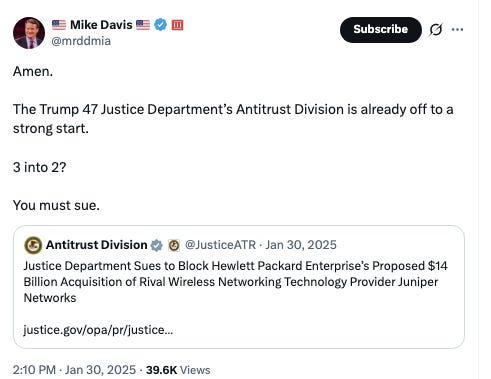
At the very beginning of the Trump Presidency, in January of 2025, Assefi, then the acting Antitrust chief, chose to sue to block Hewlett Packard’s purchase of Juniper. And Davis, oddly enough, used it to talk up the kick-ass antitrust populism of Trump.
In March, the former Antitrust chief, a J.D. Vance staffer named Gail Slater, was confirmed by the Senate. She brought into the Division a set of subordinates, including Notre Dame professor Roger Alford and antitrust lawyer Bill Rinner. Assefi remained as a deputy as well, along with a number of others.
It’s not clear when HPE hired Davis, but in mid-April, he and Levi began talking to Slater and Assefi about a settlement to let the merger go through. At first, Davis was a supporter of Slater, thinking she would help him with his corporate lobbying, while posing as a populist. On April 18th, Levi sent a settlement proposal to Assefi. At the end of the month, Schultz, Levi, Davis, and Assefi met at the boozy and exclusive Metropolitan Club in D.C., along with chief lobbyist and Senior Vice President of Hewlett Packard, Gregg Melinson.
Over the course of the next two months, the Antitrust Division, led by Slater, negotiated aggressively with Hewlett Packard, requiring a spinoff, likely of the part of Juniper Networks competitive in WLAN systems. Schultz, Davis, and Levi were frustrated, and kept going around Slater to Assefi to see if they could thwart attempts at a deal that prevented the acquisition of market power.
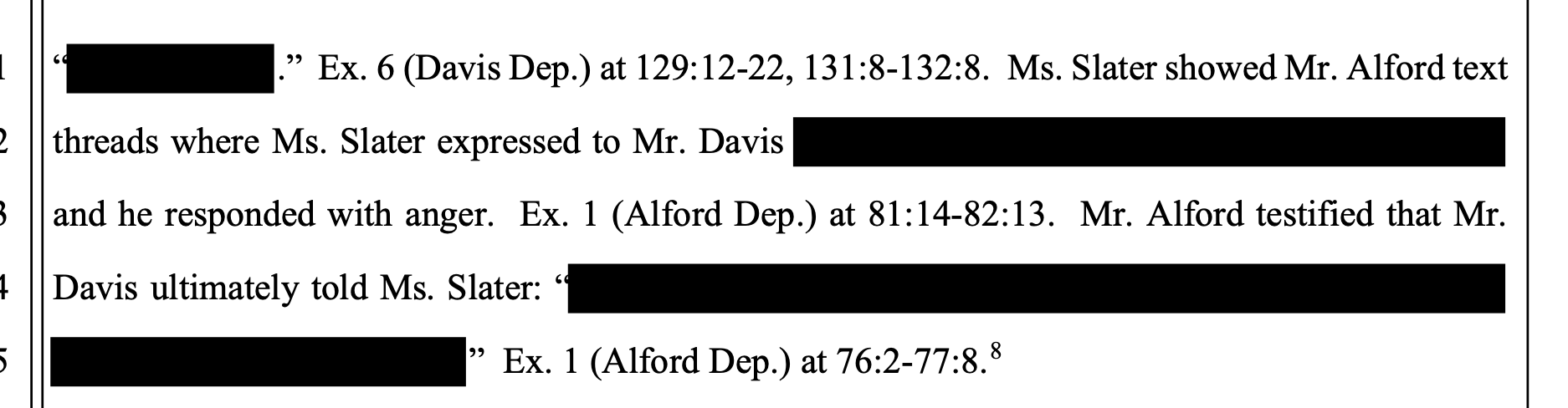
But Slater continued to resist. In mid-May, Davis had had enough, since he thought he had helped her get the job, and she wasn’t playing ball. Her “criticism enraged Mr. Davis, prompting a falling out with Ms. Slater in mid-May. Around that time, Mr. Davis had intense verbal and text exchanges with Ms. Slater.” Unfortunately, the cursing is redacted.

In June, Slater subordinate Rinner gave a public speech attacking the lobbyists and their meeting at the Metropolitan club, saying they wanted to deal with professional lawyers and economists, not to “hash out merger settlements over martinis.” Rinner then sent a demand for a real divestment to Hewlett Packard, at which point Schultz stopped engaging with the Antitrust Division entirely. Instead, he told Levi to escalate the matter to Bondi through her chief of staff, Mizelle. Mizelle assigned the negotiations to Woodward, who was not in the division and had no antitrust experience. And that was it, the entire Antitrust Division got cut out of all discussions about this merger.
On July 27th, Slater’s team got an email with the proposed settlement, as well as the Tunney Act requirement for what’s called a “Competitive Impact Statement” saying why it was a good idea. The whole package was filed that night, signed by Chad Mizelle, and not the attorneys who had worked on the case at the Antitrust Division. All of these choices, such as sidelining the entire Antitrust Division in an antitrust case, are unprecedented.
Then came the retributions, which included Davis directly and successfully lobbying President Trump to fire Slater.
“First Ms. Slater’s top two deputies were fired, and just eight months later, so was she, with Mr. Davis gloating that it was his handiwork. Mr. Woodward, on the other hand—whose nomination was still pending when the settlement was reached—chose a different path, and kept his job. Only Mr. Assefi—who liaised with Mr. Davis and Mr. Levi and entertained HPE’s initial proposals—remains. He is now the Acting Assistant Attorney General.”
That’s not the extent of the President’s involvement, Trump also personally pardoned a top private equity executive linked to Live Nation after he was indicted for bid-rigging. But what’s important is that this mass firing of less corrupt officials is how the guy who settled Ticketmaster last week got his job.
Then there’s the cover-up. In the Tunney Act, parties must disclose meetings and negotiations, to ensure that settlements are aboveboard. In this case, that didn’t happen. Davis told investigators he met alone with Assefi ten times, but disclosures listed just five in-person meetings. He met with Mizelle, that too wasn’t listed. HPE’s use of Schwartz wasn’t disclosed, and Levi also had meetings he didn’t disclose. Davis and Levi didn’t produce text messages demanded in discovery, likely because they were destroying their own communications.
While Alford testified in a deposition, the Department of Justice both smeared him and instructed him not to talk, alleging that would violate his obligation to his former client, the DOJ. Nevertheless, Alford said he witnessed DOJ wrongdoing.
There were many other strands showing the extent of of this web of corruption. Big law firm Freshfields was involved, as was defense antitrust star Beth Wilkinson. There was a national security angle; Hewlett executive John Schultz had undisclosed meetings with MAGA national security people, using lobbyist Arthur Schwartz to arrange meetings with right-wing Defense official Elbridge Colby and CIA Deputy Director Michael Ellis. None of these people talked to the Antitrust Division, but after the deal became controversial, these people leaked to Axios that they wanted the merger through to help compete with China.
The investigation isn’t done, but as Weiser and his co-authors noted, “the US completely abdicated its role as a principled defender of the antitrust laws, and through the corrupt lobbying process has abandoned any semblance of a reasoned and principled decision-making process.” Remember, these are multi-billion dollar decisions, and Schultz, almost certainly with his CEO’s approval, was probably paying a tiny fraction of the amount his firm will be extracting from customers, as well as the increase in their executive bonuses.
What Now?
So what happens now? On a tactical level, Judge Pitts can either accept the settlement, or reject it as not being in the public interest. If he rejects it, then the Department of Justice negotiates something different or drops the case entirely. The deal has already closed. States can challenge, but it will be hard, Hewlett Packard has already integrated Juniper. But the damage to Trump’s DOJ will be incalculable in terms of reputation. The Justice Department relies on a presumption of good faith, which is why judges are deferential. That will end.
More broadly, there is a now a very clear document trail for Democratic district attorneys and state officials to use for potential criminal action against corporate officials and lobbyists. And Democrats in Congress, especially if win the midterms, can delve into it.
On a more basic level, the Department of Justice is supposed to represent the public in upholding the law, but Trump officials are using it for their own sordid gain. That is a deeply corrupt set of affairs. I’m not a criminal law expert, but I have to imagine not everything here is kosher. The statute of limitations on criminal activity is long enough that the next President will be able to bring cases, if he or she so chooses. It’s just a question of gathering evidence.
And there is a lot more evidence that is likely to come out, both because the depositions in this case aren’t done, there are financial records that could be subpoena’d, and because these documents may be un-redacted. There are also other cases where there are similar files that could have explosive revelations. Ultimately, it’s hard to hide millions of dollars of payments.
I’ll end these observations with three points. First, there’s a narrative that corporate America and big law are being bossed around by a Trump administration engaged in crony capitalism. What is very clear from this document is that story is false. It was Top Hewlett Packard officials driving the corruption here, and a host of prestigious antitrust lawyers and law firms knowingly participating in return for money. (If you’re interested in this problem, AELP is doing an event on March 25th on the corruption of the legal establishment, it’s titled “Bending the Knee”).
It’s true that last year, Trump antitrust officials signaled an openness to corruption. And they are still doing it, with FTC Chair Andrew Ferguson, FCC Chair Brendan Carr, and Ossefi speaking at a forum hosted by the world’s number one merger PR firm, FGS. But Trump officials aren’t sophisticated enough to engineer these things in advance, it’s the top antitrust law nerds and corporate executives who are playing the proactive role here. many of these attorneys and lobbyists are barred in liberal states and live in Dem controlled states like NY, Maryland, Virginia or California, so they can be disbarred there as well. Keep that mind when thinking about what reform looks like and who gets included in a different governing coalition.
Second, merger law is clearly a core mechanism abused by the Trump administration. This week, Defense Secretary Pete Hegseth made antitrust central to the war in Iran, saying that the U.S. needs a “patriotic press” and encouraging cronyism around the Paramount-Warner deal.
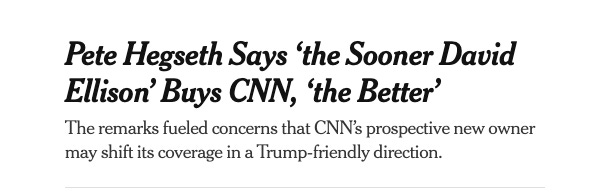
And Trump has made restructuring the media to benefit himself an open goal. So the emergence of state attorneys general as a real force in antitrust is a very good thing, since it creates a check on cronyism and corruption. We should amplify that with stronger state laws and more funding for state enforcers.
Finally, honesty, integrity, and doing work do matter. Without Alford testifying, without Judge Pitts, without Weiser and the rest of the state AGs, this corrupt viper’s nest never comes to light. Maybe that doesn’t matter. Maybe it’s irrelevant in the grand scheme of things. That’s what it often feels like, in the moment. Patman was deeply disappointed that he lost his vote to subpoena Nixon officials in 1972. It seemed dark, since Nixon won in a massive landslide election, and then escalated bombing in the Vietnam War.
But you just never know how things turn out if you pull on the right strings. And now, the rest of the monopoly round-up.
So much for draining the swamp?
Sadly, America is corrupt and broken in so many ways and it can't be sustainable in the long-term.
Honestly, I stopped reading when the attorney was described as a “boomer.“ What the hell does that have to do with anything?