
Here are the talking points (PROs and CONs) for the New Hampshire on-farm slaughter bill--consider taking such a bill to your state legislators also.
Our group met with a state Senator today and will be working on improved language for this bill, so there is still no final draft, but you know what the bill is intended to do.

Is allowing on-farm slaughter and sales for small producers a good or bad idea? NH HB396
January 16, 2026
CONS:
1. The argument is that if animals are not slaughtered in a USDA or state-inspected facility, with inspectors on duty at all times of processing, their meat is more likely to cause illness in those who consume it.
New Hampshire’s Department of Agriculture Commissioner, Mr. Shawn Jasper, pointed out that the book The Jungle, written over 100 years ago, remains relevant. He notes that the Federal Meat Inspection Act, passed 119 years ago, has stood the test of time. He thinks that all meat processors require inspections and these successfully prevent problems. He also thinks that failures at (multiple) Boars Head processing plants (which led to 10 deaths and many hospitalizations due to contamination of meat with Listeria monocytogenes) must have been due to corruption. He is furthermore convinced that farmers providing on-farm slaughter would be unable to obtain insurance.
a. But he is wrong about corruption causing the issues at Boars Head, according to the USDA’s own inspection service (FSIS).[1] https://www.foodsafetynews.com/2025/08/feds-take-over-inspections-at-boars-head-plant-linked-to-deadly-outbreak/
b. He also conflates the safety of meat obtained from a farmer butchering up to 3 cows per month with the safety of meat from large meatpacking plants that may butcher 5,000 cows per day.
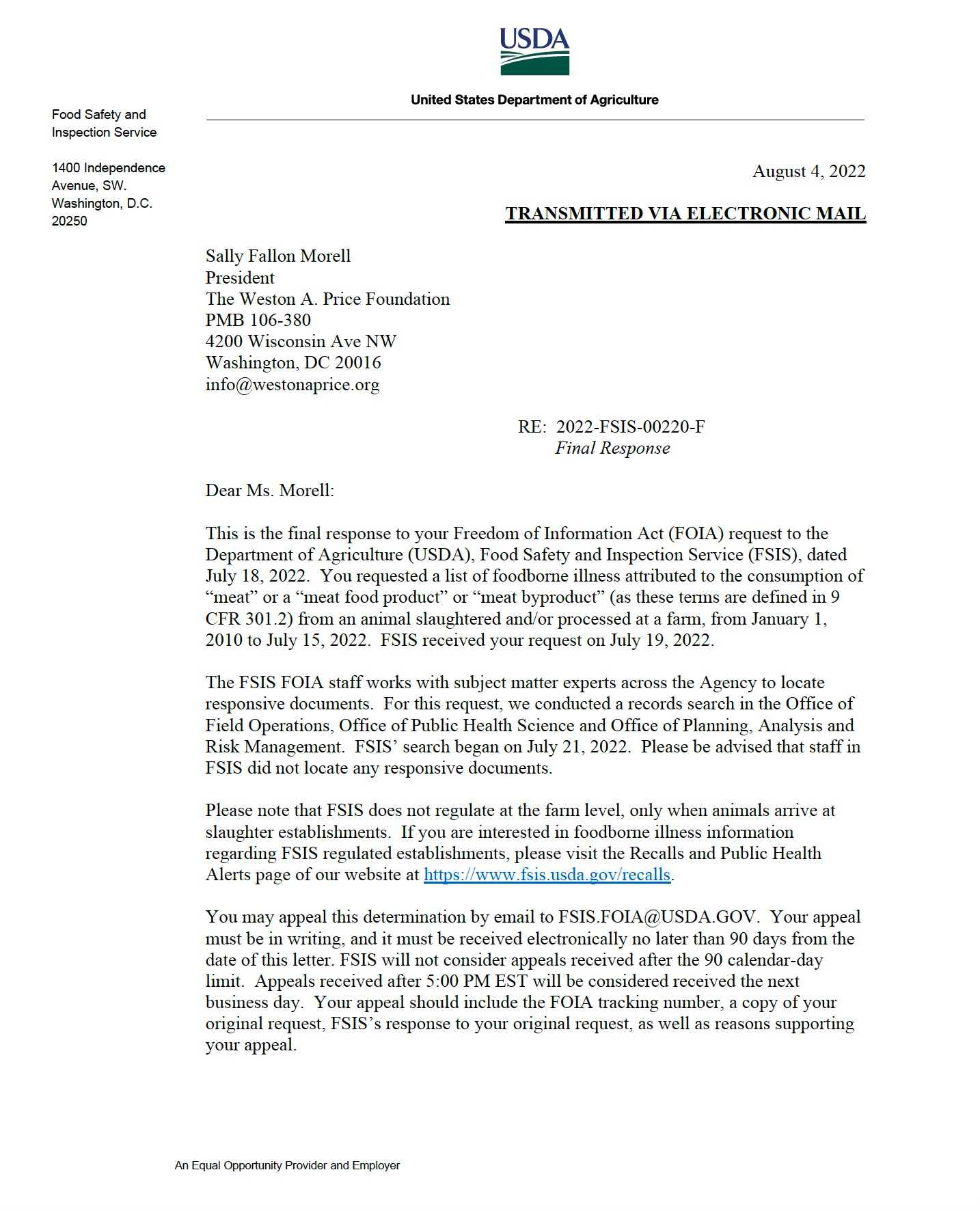
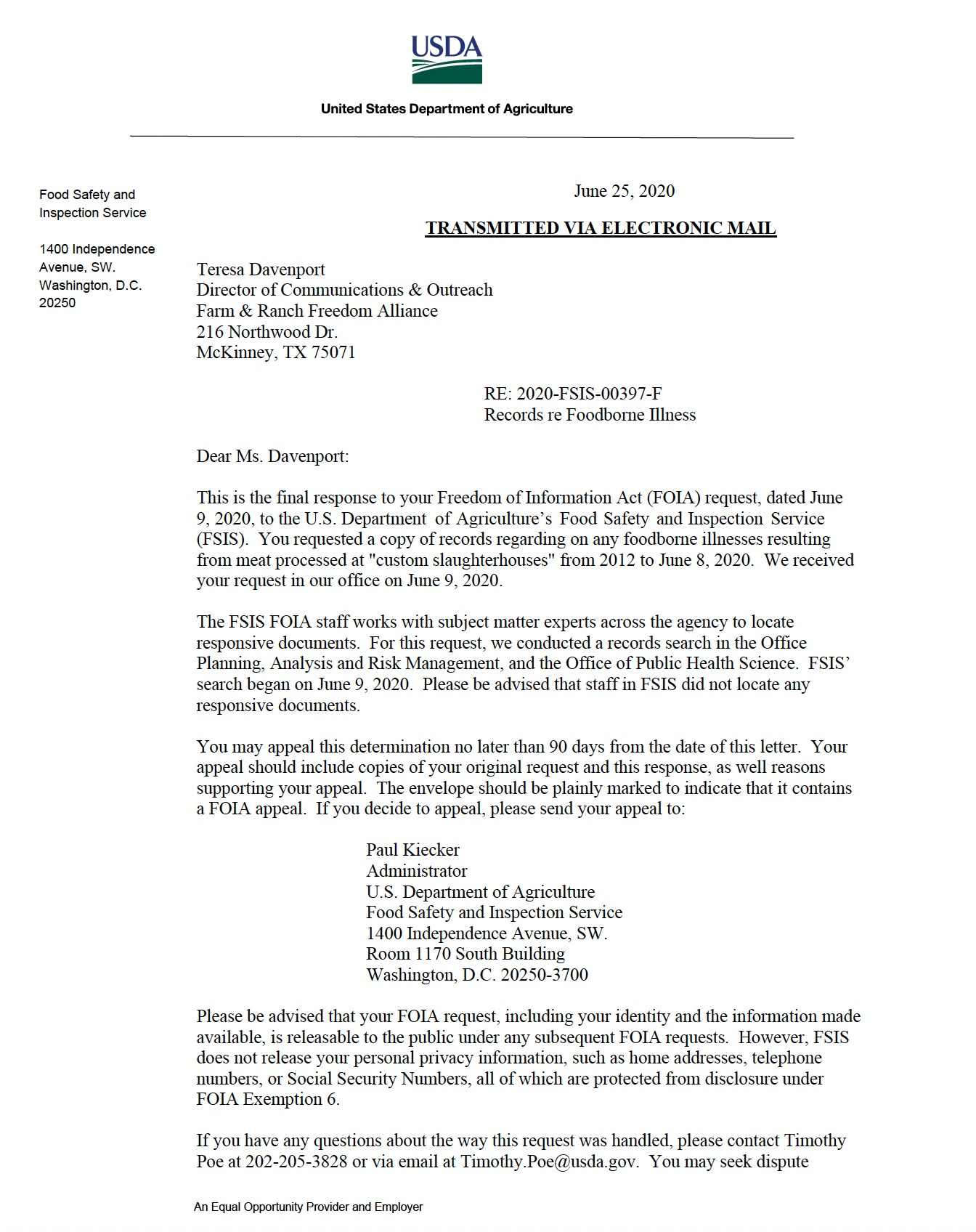
c. When USDA’s Food Safety and Inspection Service (FSIS) was recently asked to provide lists of cases of foodborne illness attributable to slaughter and processing of meat both on-farm and in custom slaughterhouses over a period of roughly ten years, the FSIS could not identify a single report of any such illness in the entire US. See the 2 FSIS responses attached.
d. If the USDA offers an exemption for very small farms processing no more than 3 cows per month or provides a statement that it will not enforce the Act on very small farms, there will be no problem getting insurance. However, we need to pass HB396 before USDA will make one of these offers.
2. The USDA requires that all cuts of meat for sale (from livestock, but not from specified numbers of poultry or rabbits) be slaughtered in a USDA-inspected or state-inspected facility. Currently, an animal’s owner may slaughter and butcher his animal, but only for personal use. It may not be sold for consumption by the public.
Mr. Jasper correctly cites a federal law, the Wholesome Meat Act of 1967. In 2017, when Maine passed a similar bill that would have allowed local regulation of meat slaughter and processing, the USDA informed that state of Maine that it would take over Maine’s state-inspected facilities if the new law was not changed. The Maine legislature was called back into session and the bill was amended to remove local control of meat processing but allow local control for other types of food.
However, today is a new day, and there are many new reasons to support HB396 that were not relevant to Maine in 2017, listed below.
Furthermore, actions by the states are anticipated to spur Congress to re-legislate this issue and/or spur the USDA to change its enforcement or exemptions, in line with state legislation.
PROS:
1. New Hampshire has only 4 USDA-inspected processing plants. Their capacity is inadequate to process all the livestock produced in the state.[2]
2. Nationally there is insufficient meat processing capacity. In some areas, ranchers must book a place with a meat processor up to 2 years in advance--even before the cow is born!
3. A meat processing bottleneck serves the (near monopoly) meat processors. It enables them to create scarcity and get paid more for providing less. It also makes room for them to import more meat, which can be raised more cheaply overseas than in the US, increasing their profits at the expense of American ranchers and customers. Over 20% of ground beef sold in the US is imported, and there is no requirement that it be labeled as such.[3]
4. 85% of beef is processed by only 4 companies in the US.[4] Four companies process 67% of all US hogs. JBS, the largest beef processor in the US and in the world, is a Brazilian company that has been convicted of bribing officials in both Brazil and the US. Its owners have spent time in jail in Brazil.[5] Why would we think this company’s products are safer than locally butchered meat? To fool their customers, JBS sells their products under more than 100 different brand names.[6]
5. The US is estimated to now be a net importer of beef: both 2 million live cows/year and over 4 billion pounds of beef are currently imported.[7] [8]
6. The US has become a net food importer in general, with imports exceeding food exports by an estimated $49 billion in 2025.[9]
7. The price of beef rose by over 16% in the last year.[10] It is at record highs.
8. The cattle herd in the US today is 86 million cows, the smallest herd since 1951: 75 years ago.[11] Brazil has surpassed the US as the world’s largest beef producer.[12] Yet the new 2026 food pyramid puts meat at the top of the foods Americans are encouraged to eat.
9. Farm and ranch input costs are at record highs. Nearly all agricultural industries for both farming inputs (seeds, fertilizer, pesticides, equipment) and the purchasers of products from the farm are controlled by near monopolies, defined as 4 or fewer companies controlling at least 60% of a national market.[13] Median farm income, according to the USDA, has been slightly negative for each of the last 5 years.[14] In other words, over half of US farms lost money each of the last 5 years, and only survived due to off-farm income from family members.
10. Knowing exactly where your food comes from and choosing to buy it directly from the farmer of your choice is almost certainly a better guarantee of its wholesomeness than is a USDA inspector positioned in a massive slaughterhouse. You will also know which country your meat comes from, something that is not possible with store-bought meat today.[15]
11. To a local farmer selling his meat locally, reputation is everything. Do you think he would willingly sell tainted meat if one bad sale could ruin all his future sales?
12. The USDA’s FSIS states that bacteria that cause ground beef to spoil “generally are not harmful.”[16] Here is the direct quote:
If the pathogens are present when meat is ground, then more of the meat surface is exposed to the harmful bacteria. Also, grinding allows any bacteria present on the surface to be mixed throughout the meat. Bacteria multiply rapidly in the “Danger Zone” — temperatures between 40 and 140 degrees F. To keep bacterial levels low, store ground beef at 40 degrees F or below and use within 2 days, or freeze. To destroy harmful bacteria, cook ground beef to a safe minimum internal temperature of 160 degrees F.
Other bacteria cause spoilage. Spoilage bacteria generally are not harmful, but they will cause food to deteriorate or lose quality by developing a bad odor or feeling sticky on the outside.
13. There are insufficient FSIS inspectors to perform adequate inspections of livestock slaughter and processing. Their number fell by 8% last year.[17]
14. Increasing the size of the US cattle herd, making farming profitable again by allowing direct farm to consumer sales, reducing the cost of meat, and helping communities to become food-resilient helps everyone--and the huge extent of our food imports is a critical national security issue, besides.[18] What happens when food imports are not available to Americans? Right now, 60% of our fruit and 35% of our vegetables are imported. Allowing on-farm slaughter and sales is the first step in turning this around.
Meryl Nass, MD and the Save Our Food and Farms Coalition, a project of Door to Freedom
[1] “The FSIS reported in 2024 that its investigation yielded several key areas for improvement including those related to sampling, inspector training, oversight of plants staffed by state inspectors, and the future of the agency’s Listeria regulatory policy.”
[2] https://newhampshirebulletin.com/2026/01/08/meat-deregulation-bill-moves-ahead/
[3] https://www.federalregister.gov/documents/2024/03/18/2024-05479/voluntary-labeling-of-fsis-regulated-products-with-us-origin-claims
[4] https://www.ers.usda.gov/amber-waves/2024/january/concentration-in-u-s-meatpacking-industry-and-how-it-affects-competition-and-cattle-prices
[5] https://www.nytimes.com/2025/06/12/climate/jbs-new-york-stock-exchange-listing.html
[6] https://jbsfoodsgroup.com/our-brands
[7] https://www.economist.com/united-states/2025/03/16/america-is-facing-a-beef-deficit
[8] https://www.ams.usda.gov/mnreports/lswimpe.pdf
[9] https://www.americanagnetwork.com/2025/10/07/once-dominant-u-s-agricultural-exports-falter-amid-trade-disputes-and-rising-competition/#:~:text=According%20to%20a%20study%20by%20researchers%20from,new%20bilateral%20trade%20agreements%20with%20different%20countries.
[10] https://www.nytimes.com/2025/06/12/climate/jbs-new-york-stock-exchange-listing.html
[11] https://www.ers.usda.gov/topics/animal-products/cattle-beef/sector-at-a-glance
[12] https://farmpolicynews.illinois.edu/2026/01/brazil-surpasses-us-as-top-global-beef-producer/#:~:text=Reuters’%20Ana%20Mano%20and%20Peter,No.%205%20beef%20shipper.%E2%80%9D
[13] https://farmaction.us/how-monopoly-agriculture-took-over-the-food-system/#:~:text=The%20Consequences%20for%20Farmers%20and,disappear%2C%20small%20towns%20hollow%20out.
[14] https://ers.usda.gov/topics/farm-economy/farm-sector-income-finances/highlights-from-the-farm-income-forecast
[15] https://www.federalregister.gov/documents/2024/03/18/2024-05479/voluntary-labeling-of-fsis-regulated-products-with-us-origin-claims
[16] https://www.fsis.usda.gov/food-safety/safe-food-handling-and-preparation/meat/ground-beef-and-food-safety
[17] https://sustainableagriculture.net/blog/usda-staffing-crisis-food-safety-agencies-struggle-as-federal-workforce-shrinks/
[18] https://farmsfeedstheworld.com/food-security-is-national-security-why-it-matters-to-everyone/
There is no way mass production slaughter houses can possibly be as safe and caring as small operations. Decentralization is better than a few centralized operations.
The nice thing about buying directly from the farmers is your helping them without the middleman the price is much lower, and your getting real meat with no fillers or water added. The flavor is awesome compared to store bought. Plus you can fill your freezer by getting 1/4 or the whole cow. You can also go together with family and split the meat according to your family size.
We are retired milk, and beef farmers, and we know the work that goes into it, so we’re willing to pay the price for grass fed, and no vax.