
THIS WEEK: Pesticides are about to get a liability shield similar to the one for vaccines--unless there is a *miracle* or two. Could Bayer's $Billions Take Over Every Branch of Government?
2 pending Monsanto bills in Congress, pending bills in state legislatures, and a pending decision on Certiorari in the Supreme Court--all need to be defeated to stop this

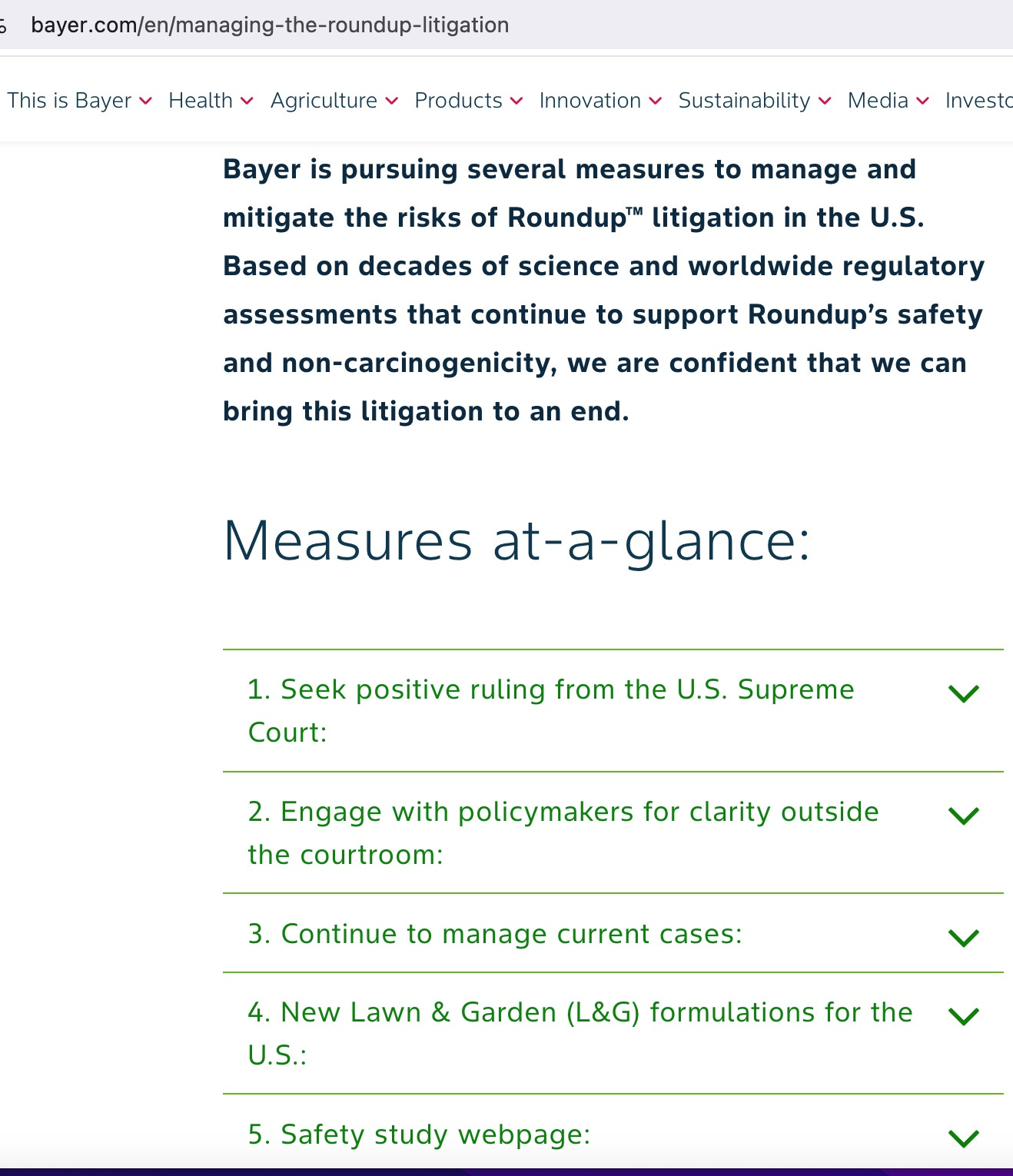
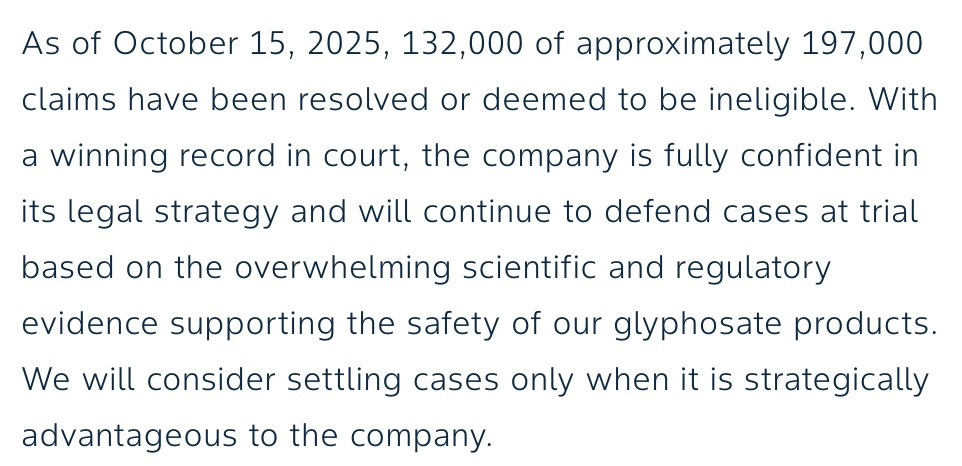
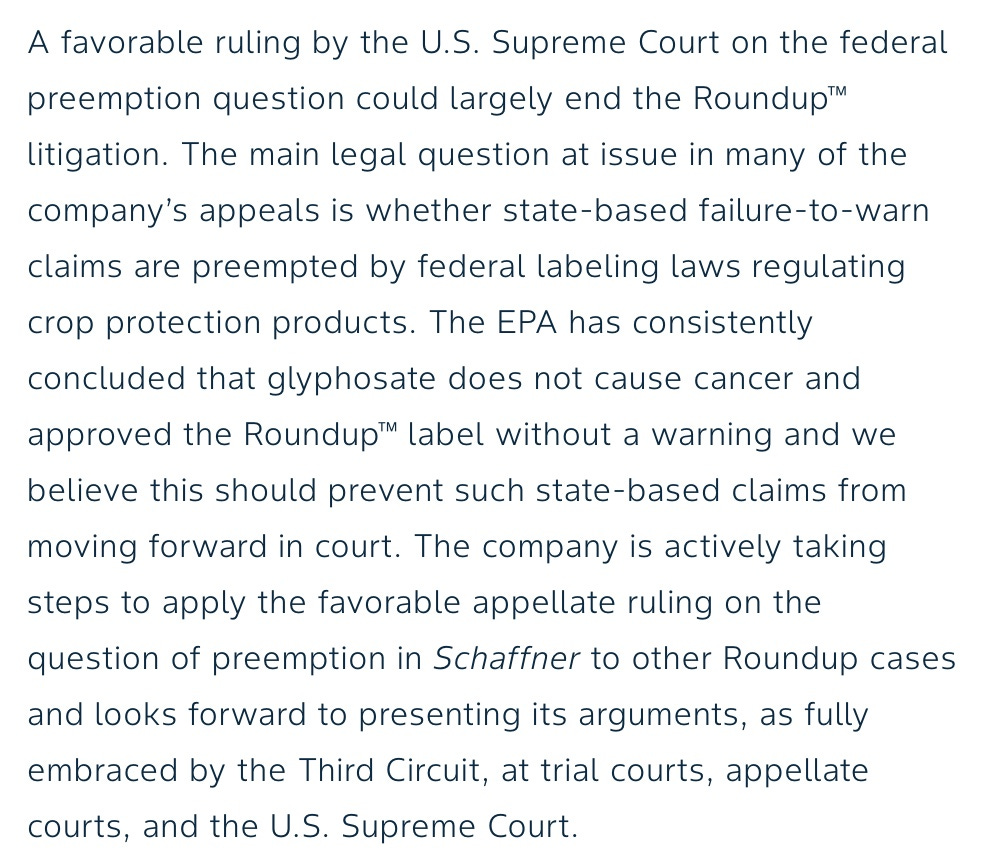
Bayer is throwing everything they have at this challenge, because it is a threat to the company’s very survival. Below is from Bayer’s Roundup litigation website.
The information below was written by me as a Fact Sheet on this subject.
What would a pesticide liability shield do?
If you are harmed or killed by a pesticide, your family will not be able to sue for damages or receive compensation
There will be no incentive for manufacturers to make safer products
And manufacturers do not even need to list all the ingredients in their products, if they claim they are “inert” or inactive ingredients, despite their toxicity--so you can’t even know what you are buying.
What is going on?
Monsanto made the herbicide (a pesticide) Roundup, which was paired with “Roundup-ready” GMO seeds. Roundup allowed the GMO crops to grow unimpeded, while reducing most other weeds. It soon became the largest-selling pesticide in the world.
Roundup’s main active ingredient was glyphosate, but there are many different mixes that are sold as Roundup, which include other pesticides.
The German company Bayer purchased Monsanto for $63 Billion dollars in 2018.
A few months later, a case brought against Roundup for causing non-Hodgkin lymphoma in a school groundskeeper was won by the plaintiff in a California state court, who received a jury verdict of $289 million dollars. Substantial evidence was presented that Monsanto knew of this side effect but concealed it. His award was later reduced on appeal to $21 million.
This was the first case of its kind to succeed. Roundup was used by tens of millions of Americans, and 80,000 cases of non-Hodgkin lymphoma are diagnosed yearly in the US. Over the ensuing years, about 200,000 plaintiffs joined lawsuits against Monsanto-Bayer for alleged injuries caused by the company’s failure to warn.
In a tacit admission of guilt, Monsanto-Bayer then removed glyphosate from the household formulation of Roundup
Monsanto-Bayer has lost some cases and won some and settled with most claimants, spending $10 billion dollars so far, while about 60,000 cases remain outstanding.
Monsanto-Bayer developed an aggressive plan to use every legal means at its disposal to beat back its liability for glyphosate:
Monsanto-Bayer’s Clever Plan to Evade Liability
The plan relied on the fact that the EPA has allowed Bayer-Monsanto to keep cancer warnings off its products, despite considerable evidence to the contrary, and that EPA has relied on Monsanto’s ghostwritten studies for its evidence.
State courts have accepted additional independent evidence that was kept off the EPA-approved warning label. Recently, a 2000 landmark paper claiming the safety of glyphosate was retracted when it was revealed that it had been ghostwritten by Monsanto employees.
The next step was to write a bill that made it much harder to change an existing EPA label --for all of the 20,000 registered pesticide products in America. This bill (Section 453) has been approved by the Interior/EPA Appropriations Committee of the House and is expected to be voted on by the entire House in the next 1-2 weeks. Senators are being lobbied to add it to the final bill, which will be approved soon after.
Chairman Glenn Thompson of the House Agriculture Committee has promised to include a pesticide liability shield in the Farm Bill, expected to be considered later this month.
In case the bills in Congress are not successful, Monsanto-Bayer got bills introduced in about 20 state legislatures that would make the EPA label decision the final word on injuries. These bills have already passed in Georgia and North
CarolinaDakota.The final government strategy employed by Monsanto-Bayer was to ask the Supreme Court to rule on a case it lost in a lower court (Monsanto v. Durnell) and to issue a judgement that would disallow state court actions, forcing the states to accept EPA’s judgement as to safety. Here are the filings in the case. The Supreme Court justices will conference on it January 9, when they decide whether to take the case.
The Supreme Court asked the US Solicitor General to weigh in with the government’s opinion about this case. On December 1, the Solicitor General, representing the DOJ and the Executive Branch, asked the Supreme Court to take the case, and to rule in Monsanto-Bayer’s favor. The Solicitor General misrepresented the WHO’s International Agency for Research on Cancer (IARC) assessment of glyphosate, claiming the IARC found it to be a possible carcinogen, when actually it was found to be a probable carcinogen.
If the Supreme Court rules in favor of Bayer-Monsanto, the bills in Congress and state legislatures won’t matter--the EPA label will be the only guidance that courts will be able to follow.
For decades, the EPA has sided with industry to minimize the risks of human exposures to pesticides and other chemicals in our food, air and water, so it makes sense for Monsanto-Bayer to expect that the EPA will continue to approve warning labels that fail to acknowledge cancers and other risks.
But Bayer-Monsanto did not stop with legal maneuvers. The company formed an industry lobby group (the Modern Ag Alliance) for help with advertising and lobbying, enlisting over 300 other pesticide companies to join them.
Every pesticide sold in the US would receive the same type of liability shield if Monsanto-Bayer wins in the state legislatures, the Congress or the Supreme Court.
There has been intense lobbying on the Appropriations bill to members of both parties, and the narrative provided by lobbyists and some Congressmembers about the Appropriations Bill rider has falsely denied it would waive liability, despite Bayer admitting it.
The company currently has set aside a $7 Billion war chest to deal with lobbying and advertising costs, plus future claims.
Can a $7 Billion War Chest Buy a Liability Shield for all Pesticide Products?
Americans are About to Find Out. How Can this be Stopped?
First Miracle: We stop the Liability Shield in the Appropriations Bill and the Farm Bill: Contact all your Congressmembers, explain this situation, and demand they vote against this liability shield. Do it now! The Appropriations Bill, and the Supreme Court decision on whether to take the case, are probably coming up this week. The court will be paying attention, if we can get publicity against the Section 453 rider in the House bill and can stop the Senate from voting in favor too. Our best chance is to speak with a very loud voice, which will hopefully influence the Supreme Court to refuse to hear the Monsanto v. Durnell case. Identifying how this issue has been misrepresented by lobbyists and the Solicitor General may be helpful.
Second Miracle: The Supreme Court refuses to take the case, or rules against Monsanto-Bayer.
Third Miracle: the EPA, despite being stuffed with industry shills, suddenly starts regulating in favor of American citizens.